Help, contact and request tracking
Find an answer. Reach the right STEMMING team.
Use the reviewed answers for common questions or send a focused request for cohort guidance, accessibility support, academic adoption or collaboration.
Start with the closest topic
Six practical routes to support
Choosing a topic helps the project team route your message without asking you to repeat the same context.
Cohorts and eligibility
Dates, audiences, prerequisites, workload, application routes and cohort conditions.
Account and access
Sign-in, registration, password recovery, saved choices and access to learning links.
Accessibility and participation
Accessible formats, participation barriers and reasonable support for project activities.
Academic adoption
Course mapping, staff development, quality evidence and local implementation planning.
Industry collaboration
Challenges, datasets, mentoring, internships, pilots and venture collaboration.
Project information
Project scope, partnership enquiries, dissemination and other questions.
Human-reviewed request
Send the context needed for a useful response.
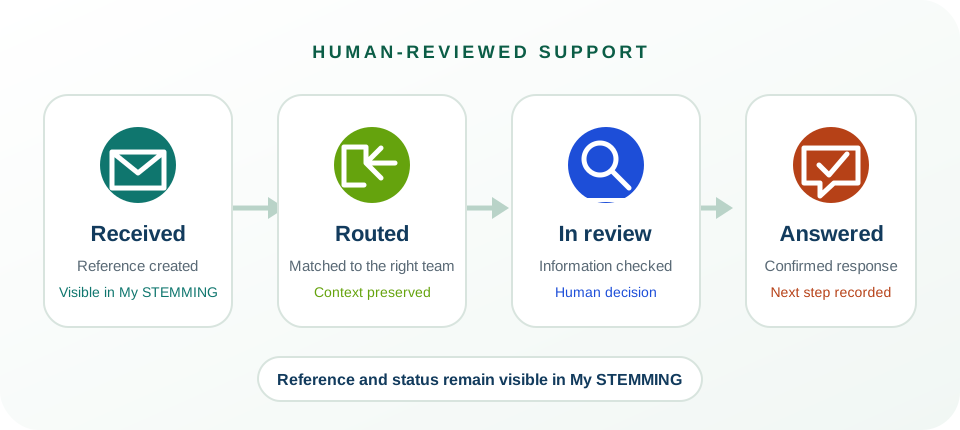
After submission you receive a reference. Signed-in participants can follow its current status in My STEMMING.
- ReceivedYour request is recorded with a reference.
- RoutedIt is directed to the relevant project team.
- In reviewThe team checks the information and next action.
- AnsweredYou receive the confirmed response or route forward.
Verified account required
Start with your email address.
A verified STEMMING account is required so the project can route, acknowledge and track your request securely.
Join or sign inReviewed project answers
Frequently asked questions
These answers describe the common project model. A confirmed cohort page provides the final local details for participation.
What is STEMMING?
STEMMING is a European higher-education initiative developing short, assessed learning across Agentic AI, smart green and solar systems, quantum trust and security, and venture creation.
Who is the training for?
The main audiences are BSc, MSc and PhD learners, academic staff, professional university staff and selected ecosystem participants. Each cohort page confirms its own level, prerequisites and local eligibility.
How is the offer organised?
The public architecture contains four connected pillars and eight stackable mini-credentials. Local courses, challenge weeks and staff-development offers can implement those credentials in different settings.
How much time does a credential require?
A successful project completion is designed around at least 10 structured learning hours plus competence assessment. Any larger workload or local ECTS equivalence is confirmed by the delivering institution for a specific cohort.
What evidence will I produce?
Depending on the credential, evidence may include a quiz, notebook, design worksheet, scenario decision, short report, pitch or project artifact. The course page states the assessment before enrolment.
Will I receive a certificate or credit?
Successful learners may receive a project or delivering-HEI credential under the approved procedures for that cohort. Local recognition, ECTS equivalence and issuer wording are never assumed and must be confirmed on the course page.
How does AI support work?
The project model combines AI-assisted explanations and guidance with human oversight and escalation to qualified educators or support staff. The portal guide helps people find reviewed project information. Assessment, eligibility and support decisions remain with the responsible human team.
How are internships, mentoring and venture opportunities offered?
STEMMING publishes challenge, mentoring, internship and venture opportunities as separate calls, each with clear eligibility, capacity, timing and selection information.